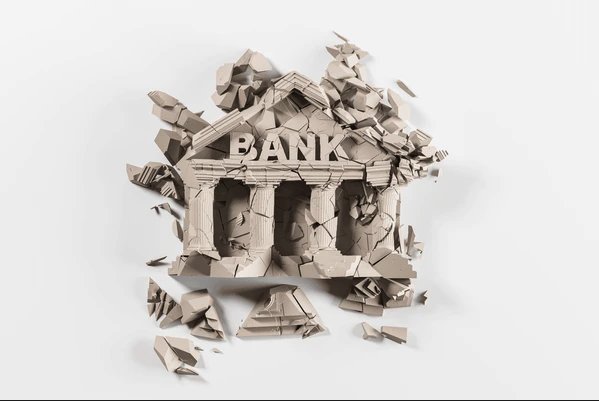
When IOUs break: why real assets are the substance under the paper.
For a century, government and bank IOUs have been treated as the definition of "safe." This brief is a macro argument, not portfolio advice, about why, under strain, value concentrates in the tangible and useful, and why that is the real case for putting real-world assets onto verifiable rails.
For most of the last hundred years, the safest thing a person or institution could hold was a promise: a government bond, a bank deposit, a paper claim on a future payment. That worked because the issuers were trusted and the currency was stable. But when total debt runs at multiples of GDP, and purchasing power has been steadily eroded over decades, it is worth asking a sharper question, what is actually underneath the promise?
This is a thesis piece, and it should be read as one. It is not investment advice, and it does not recommend that anyone buy or sell anything. It is an argument about where economic substance lives, and why that has direct implications for how financial infrastructure should be built.
The core problem: promises depend on trust
An IOU, any IOU, is only as good as the issuer's ability and willingness to pay in real terms. When a system's debt stack outruns its productive growth, it tends to lean on a familiar set of pressure valves:
- Higher taxes and fees, which quietly drain the real economy.
- Financial repression, holding interest rates below inflation so debt erodes in real terms.
- Devaluation, repaying obligations in weaker money.
In each case, the paper promise becomes the shock absorber for the system. That is not a moral judgment about any government or bank. It is a structural observation about how leveraged systems behave under strain.
Safety, in the end, is not in the paper. It is in things that remain useful and scarce regardless of who is solvent.
What actually holds value when credit cycles strain
When credit conditions tighten sharply, usefulness and scarcity tend to matter more than yield. Broadly, value concentrates in a few categories:
Productive real estate
Shelter and productive land remain indispensable. Essential housing, workforce rentals, and agricultural or utility-linked land hold value because demand for them does not disappear with the credit cycle, especially when the leverage against them is modest enough that the cash flow carries it.
Operating businesses that sell necessities
Food, energy, basic transport, repair, healthcare, utilities, compliance services. Businesses that convert inventory into cash quickly and can reprice with inflation tend to keep functioning when discretionary, credit-dependent models do not.
Precious metals and other scarce, verifiable stores of value
Physically held, independently verifiable scarce assets have historically been used to bridge currency resets, precisely because they carry no counterparty dependency. They are volatile, and they are not a recommendation here, but they illustrate the principle: scarcity plus verifiability equals resilience.
What ties these categories together is not a "trade." It is that each is tangible, useful, and scarce, a claim on real value rather than a claim on someone else's solvency. The weakness of every one of them, historically, has been the same: they are illiquid, hard to verify, and hard to move without intermediaries.
The infrastructure question this raises
Here is where the thesis becomes concrete, and where it stops being about portfolios. If real-world assets are the substance under the paper, then the most useful thing finance can do is not tell people what to own. It is to build the rails that make real-world assets verifiable, transparent, and able to move without depending on opaque intermediaries.
That is exactly the problem a regulated real-world asset exchange exists to solve. Bringing tangible assets, real estate, infrastructure, productive cash flows, onto regulated, auditable infrastructure does not change what they are. It changes whether their value can be verified, financed, and settled with the same speed and transparency that paper instruments have always enjoyed. It gives real assets the liquidity and proof-of-ownership that, until now, only IOUs had.
Be sober, not scared
None of this is a forecast of collapse, and it should not be read as fear-marketing. Real estate is illiquid, taxed, and policy-sensitive. Operating businesses carry real operational risk. Scarce assets are volatile. Every category has trade-offs, and a thesis about structure is not a prediction about timing.
The durable point is simpler and calmer: in any environment where confidence in paper promises is tested, the assets that hold up are the ones with genuine, verifiable substance behind them. The role of modern financial infrastructure, and the work KCS Capital researches and 4orm Finance is being built to deliver, is to make that substance transparent, auditable, and liquid within Canada's regulatory framework. That is how you give real value the infrastructure that paper has always had.
Background & Sources
- Global debt-to-GDP levels, Institute of International Finance Global Debt Monitor.
- Long-run purchasing power and inflation history, Bank of Canada.
- Real-world asset tokenization and verifiable settlement infrastructure, McKinsey & Company tokenization research and the Canadian Investment Regulatory Organization.
This brief is thought-leadership commentary from KCS Capital. It is a macroeconomic thesis for informational purposes only. It is not investment advice, not a recommendation to buy, sell, or hold any asset or asset class, and not an offer or solicitation of securities. Any reference to asset categories is illustrative of an argument about economic structure, not guidance. Readers should consult their own qualified financial, legal, and tax advisors before making any decision. KCS Capital Inc. is an independent technology and research firm; 4orm Finance operates as a separate regulated entity.