Governments don't fail because of bad intent. They fail because their financial infrastructure is outdated.
When a public program underperforms, the debate goes straight to politics: who approved it, who mismanaged it, who should be blamed. That framing misses the deeper issue. Most public spending failures are not governance failures. They are infrastructure failures.
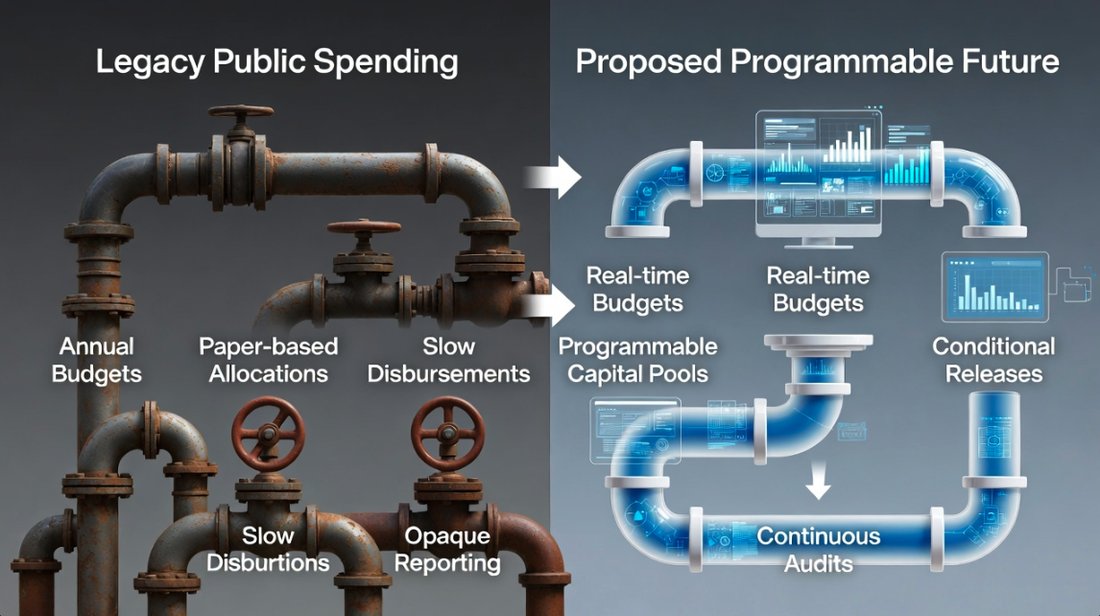
Canada is trying to run 21st-century economic programs on 20th-century financial plumbing. Budgets are approved in spreadsheets. Contracts are managed in PDFs. Funds are released through batch payment systems. Performance is reported months later in static documents. By the time a problem becomes visible, the money is already spent and the political narrative has already hardened.
That is not a failure of intent, and no amount of better messaging or post-hoc auditing fixes it. It is a failure of a system that was never designed for real-time accountability, outcome-based funding, or continuous public verification.
The hidden design flaw in public finance
Public finance was built around a simple assumption: money moves first, accountability comes later. That made sense in a paper-based world. It makes very little sense in a digital economy where capital moves at machine speed, supply chains are complex, and programs route through dozens of intermediaries.
The result is a predictable pattern. Budgets are approved at the political layer. Funds flow through administrative layers. Contractors and sub-contractors execute. Outcomes are inferred later. Audits arrive long after the capital is gone. And public trust erodes regardless of whether anyone did anything wrong.
This structure does not just create waste. It creates fragility, systems vulnerable to misalignment, optics-driven decisions, and quiet drift between what was promised and what was delivered.
What if public money worked like institutional capital?
In modern finance, sophisticated institutions do not move large sums blindly and reconcile later. They use escrow, milestone-based releases, performance triggers, embedded risk controls, continuous reporting, and governance committees with real enforcement power. Public finance, ironically, does not operate this way at scale.
A regulated real-world asset exchange changes that, not by "putting government on crypto," but by giving public money the same structural properties that sophisticated private capital already has:
- Conditional release, funds move only when defined conditions are met.
- Embedded rules, the terms of a funding agreement are enforced by the system, not by memory.
- Verifiable checkpoints, performance is confirmable in near real time, not inferred quarters later.
- Immutable audit trails, every decision is recorded as a property of the system.
- Separation of execution from political pressure, mechanics, not narratives, govern disbursement.
This is the shift from discretionary funding to programmable funding.
A regulated RWA exchange is not just a marketplace. At an infrastructure level, it is a financial operating system.
An exchange is an operating system
Most people picture an exchange as a place where assets trade. But at the infrastructure level, a regulated real-world asset exchange governs how assets are issued, how they are custodied, how value settles, who has permission to move funds, what rules govern transfers, and what data is visible and auditable.
Extend that operating system to public finance and you do not "digitize spending", you re-architect how spending works. Budgets become programmable capital pools. Contracts become enforceable financial logic. Payments become conditional outcomes rather than administrative events. Audits become a continuous system property rather than a retroactive investigation.
Why this matters politically, without being partisan
One of the least discussed failures in public finance is that political leadership is often forced to manage optics instead of outcomes. When accountability is delayed and opaque, good programs get lumped in with bad execution, political risk discourages long-term infrastructure thinking, and short-term image management replaces long-term system design.
A programmable financial layer changes that dynamic. When funds release only as predefined conditions are met, and performance is verifiable in near real time, leaders are no longer defending narratives, they are pointing to mechanics. It lets the conversation move from "trust us" to "verify the system." That is how you depoliticize execution without depoliticizing democracy.
Even modest efficiency gains, in the low single-digit percentages, across large public programs translate into billions of dollars per year of recovered capacity. But the bigger impact is compounding: programs scale faster because funding is automated, contractor dependence shrinks as outcomes are enforced, audit costs fall as verification becomes built-in, data quality improves because reporting is native to the system, and public trust improves because verification is no longer discretionary.
What KCS Capital is actually building
KCS Capital is not building "a crypto solution for government." It is an independent technology and research firm developing the financial infrastructure layer that allows capital, public or private, to move with rules, transparency, and verifiability. That infrastructure is being built out through 4orm Finance, designed as Canada's institution-grade regulated real-world asset exchange and digital settlement network.
In practical terms: a regulated RWA exchange becomes the settlement layer; smart contracts become the execution logic; tokenized agreements become enforceable funding contracts; governance frameworks become continuous oversight; and public dashboards become trust infrastructure. It is a bridge between traditional public finance and modern capital systems, without asking government to abandon its legal, regulatory, or institutional foundations, and built to operate squarely within Canadian regulatory frameworks.
From trust-based spending to verifiable spending
Modern societies run on trust. But trust without verification eventually breaks. The next phase of public finance is not about smaller government or bigger government, it is about better government infrastructure.
When public money moves through systems that enforce outcomes, record every decision, and make performance visible by design, the question changes. Not "did they misuse funds?" but "did the system even allow misuse in the first place?" That is the difference between managing failure and designing it out of the system entirely, and it is what regulated financial infrastructure like 4orm Finance is built to deliver.
Background & Sources
- Public spending oversight, program evaluation, and audit cadence, Office of the Auditor General of Canada.
- Tokenized bond and settlement infrastructure validation in Canada, Bank of Canada digital settlement work.
- Regulated digital asset exchange and custody framework, Canadian Investment Regulatory Organization and the Canadian Securities Administrators.
This brief is thought-leadership commentary from KCS Capital. It is for informational purposes only, describes a conceptual infrastructure approach rather than a current product or offering, and does not constitute an offer or solicitation to buy or sell securities, or financial, legal, or tax advice. KCS Capital Inc. is an independent technology and research firm; 4orm Finance operates as a separate regulated entity.